Sea sparkle returns to the Dutch coast during heatwave
Sea sparkle has returned to parts of the Dutch coast during the heatwave, but a hot day alone does not guarantee glowing blue waves at night.

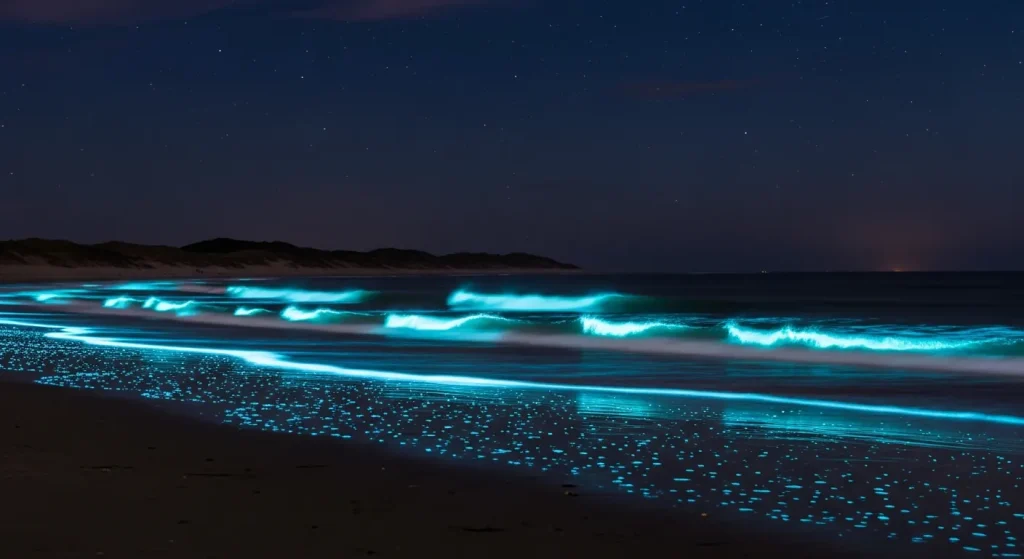
Sea sparkle has returned to parts of the Dutch coast during the heatwave, drawing people to beaches at night in the hope of seeing blue glowing waves.
The natural phenomenon is known in Dutch as zeevonk. In English, it is called sea sparkle. The scientific name of the organism is Noctiluca scintillans.
The light effect is called bioluminescence. This means that a living organism produces light through a chemical reaction. In the case of sea sparkle, tiny single-celled organisms in the water flash blue when the water moves.
That is why the glow is usually seen in breaking waves, foam, wet sand or shallow water. Footsteps, splashes and small waves can all trigger the light.
Quick explainer · why does sea sparkle glow?
Sea sparkle is caused by Noctiluca scintillans, a tiny single-celled organism in the water. It does not glow all the time. It flashes when the water moves.
Inside the organism, a chemical reaction takes place. A molecule called luciferin reacts with oxygen, helped by an enzyme called luciferase. That reaction releases energy as blue light. This is called bioluminescence.
The glow is easiest to see after warm days, when many organisms gather near the coast. But the bloom must also stay close to shore, the beach must be dark, and the water must move just enough to trigger the light. That is why sea sparkle can be amazing 1 night and invisible the next.
Why sea sparkle is appearing now
This week’s sightings are linked to the warm and sunny weather.
Sea sparkle is most likely after several warm days in a row, especially when shallow coastal water has warmed up and the sea is relatively calm. The organisms can then gather near the shore in large numbers. When enough of them are present, movement in the water can create a visible blue glow after dark.
Natuurmonumenten says the best chance comes during warm and calm weather, when sea sparkle can move toward the coast. Weeronline also notes that sea sparkle often appears after a series of warm, sunny days, especially in warm, shallow and calm seawater.
During the day, sea sparkle can sometimes be visible in a very different way. Instead of blue light, the water may look salmon pink, orange, brown or rusty. That colour can be a sign that many organisms are present near the surface.
At night, the same bloom can turn into a light show.
But this is also where many people get disappointed. A warm day does not guarantee sea sparkle.
How sea sparkle actually starts to glow
Sea sparkle does not glow because the sea is hot. It glows because tiny organisms in the water react to movement.
The organism behind the glow is Noctiluca scintillans. It is a single-celled plankton organism. During the day, a large concentration can sometimes look like a salmon, orange, brown or rusty patch in the water. At night, the same patch can turn into blue light when the water is disturbed.
The easiest way to understand it is like this:
- Warm weather helps the organisms build up near the coast. After several warm and sunny days, shallow coastal water can become a good place for sea sparkle to multiply. Calm weather helps the organisms stay closer together instead of being spread out by wind and waves.
- During the day, the bloom may look muddy or orange. This is why beachgoers often look for strange colours in the water before sunset. A brown, orange or salmon tint can mean there is a high concentration of sea sparkle near the surface. It does not always guarantee a glow later, but it is one of the best clues.
- Darkness makes the reaction visible. The organisms may be present during the day, but the light is too weak to see in sunlight. After dark, even small flashes can become visible in waves, foam, wet sand or shallow water.
- Movement triggers the flash. Sea sparkle lights up when the water around it is disturbed. Breaking waves, footsteps, splashes or even a hand moving through shallow water can trigger the reaction. Ecomare describes the glow as a chemical reaction caused when the organism is moved strongly, likely as a defence response against predators.
- The glow is chemistry, not magic. Bioluminescence usually needs 3 things: a light-producing molecule called luciferin, an enzyme called luciferase, and oxygen. When luciferin reacts with oxygen, helped by luciferase, energy is released as light.
- In the sea, the light usually looks blue or blue-green. That colour travels well through water, which is why many marine bioluminescent organisms appear blue or green rather than red or yellow.
So the full chain is:
→
Bloom builds up
→
Bloom stays near shore
→
Darkness falls
→
Water moves
→
Chemical reaction
→
Blue flash
If 1 part of that chain breaks, the sea may not glow.
That is why a beach can be spectacular 1 night and completely dark the next.
Why it can disappear so suddenly
Sea sparkle is not a lamp that switches on every night. It is a living bloom moving through a changing sea.
A hot day can help create the right background conditions, but it does not guarantee a glow. The bloom still has to be close to the beach, concentrated enough and triggered by the right kind of movement.
If wind pushes the bloom away from the shore, people on the beach may see nothing. If waves mix the organisms deeper into the water, the glow may become too weak to notice. If the bloom spreads out, there may still be sea sparkle in the sea, but not enough in 1 place to create bright blue waves.
This is probably what happens when Scheveningen glows for several nights and then suddenly stops.
It does not mean the sea sparkle has died because the air reached 37°C. The sea does not warm as fast as the air. The more likely explanation is that the bloom moved, dispersed, sank deeper, aged or was mixed by wind and currents.
A strange daytime colour can be a clue, but even that is not perfect. A bloom can look visible during the day and still produce only weak light at night if the conditions are not right.
That uncertainty is part of the phenomenon. Sea sparkle is not only a weather event. It is biology, chemistry and sea movement happening at the same time.
Why 37°C does not mean the sea will glow
Many people assume that if the air is extremely hot, sea sparkle must appear at night. That is not how it works.
Heat helps create the background conditions, but sea sparkle also depends on wind, waves, currents, darkness and whether the bloom is still close to the beach.
A day of 35°C to 37°C can help warm coastal water, but the sea does not heat up as fast as the air. Land and air can become extremely hot in a few hours, while seawater changes more slowly. That means a very hot afternoon does not instantly create or destroy sea sparkle.
The real question is whether the organisms are concentrated near the shoreline at night.
If wind pushes the bloom away from the beach, the glow may disappear. If waves mix the organisms deeper into the water, they may become harder to see. If the bloom spreads too thin, there may still be sea sparkle in the sea, but not enough to create a clear blue glow.
That is why Scheveningen can glow for several nights and then suddenly look normal again.
Did the heat kill the sea sparkle?
Probably not.
Extreme air temperature alone does not mean the sea sparkle is dead. A more likely explanation is that the bloom has moved, dispersed, mixed deeper into the water or changed stage.
Ecomare explains that sea sparkle gives light when it is moved by turbulent water. It also says that during rough weather, sea sparkle can move to deeper and quieter water. That can make it much harder to see from the beach.
Another reason is the life stage of the bloom. Sea sparkle blooms can appear as red, brown or orange patches during the day. In some cases, large blooms may contain ammonia or ammonium and can irritate skin or airways. Ecomare and Dutch water safety sources advise rinsing with fresh water after swimming in a bloom if irritation occurs.
So if people do not see the muddy, salmon or orange colour during the day, that may be a warning sign that tonight’s chance is lower. It does not mean the organism has vanished from the North Sea. It may simply not be concentrated where people are looking.
If the sea does not glow, it does not mean the sea sparkle is dead. It may simply have moved on.
The takeaway
What about tonight?
The chances around Scheveningen are uncertain.
The Hague area is under extreme heat conditions today, with a forecast high around 35°C and a red warning for extreme heat in South Holland. The same forecast also points to a thunderstorm warning for Saturday evening.
That creates a mixed picture.
The recent heatwave is good for sea sparkle in general. But tonight’s actual chance depends on local sea conditions. If the water near Scheveningen looked clear during the day and no one saw the usual salmon, orange or brown discolouration, the chance may be lower than earlier this week.
Wind also matters. Sea sparkle is easier to see during calm evenings with gentle waves. Too much wind can spread the bloom, push it away from shore or make the water too disturbed in the wrong way. Buienradar notes that sea sparkle is easier to spot when the sea is not rough and the wind is not strong.
The best advice is to check fresh sightings before travelling. If people are reporting blue flashes in foam or wet sand near Scheveningen, Katwijk, Noordwijk, Zandvoort or another nearby beach, the chance is better. If there are no fresh reports and no daytime discolouration, it may be a dark sea night.
What about tomorrow and the next days?
Saturday may be difficult because thunderstorms are possible in South Holland during the evening. Thunderstorms, gusts and heavy rain can quickly disturb the water and make sea sparkle harder to see.
Sunday looks less hot, with a forecast high around 26°C in The Hague. That does not rule out sea sparkle. A cooler day after a hot week can still produce a glow if the bloom remains nearby and the sea becomes calm again.
The key point is this: sea sparkle is not a normal weather forecast. It is a biological event shaped by weather, water movement and timing.
A hot week can create good conditions. But each night still depends on whether the bloom is in the right place at the right time.
Best conditions for sea sparkle
The best chance usually comes when several conditions line up:
Best conditions checklist
- Warm and sunny days before the sighting
- Calm or lightly moving seawater
- Little wind
- A dark beach with little artificial light
- A bloom close to the shore
- A salmon, orange, brown or rusty colour in the water during the day
- Recent reports from the same beach or nearby beaches
The best time is usually late at night, after it is fully dark. Around the Dutch coast in summer, that often means waiting until well after sunset.
Beach lights, phone screens and a bright moon can make the glow harder to see. Give your eyes time to adjust before deciding nothing is there.
Where to look
Sea sparkle can appear along many parts of the Dutch coast. Popular places for sightings include Scheveningen, Katwijk, Noordwijk, Zandvoort, Zeeland and the Wadden Islands.
Beach guide
Scheveningen is the focus during this heatwave, but the glow can show anywhere the bloom drifts close to shore. Treat this as a smart starting point, not a promise.
Best clues
- Go late. Wait for full darkness, not sunset.
- Pick a dark beach. Less street light makes a weak glow easier to see.
- Watch the surf. Blue flashes often show where small waves break.
- Check fresh reports. If one spot is quiet, move along the beach.
But there is never a guarantee. One beach can glow while another beach only a few kilometres away stays dark.
Zeevonkvoorspelling uses weather, tides, seasonal patterns and reports from spotters to estimate where the chance is higher. It can be useful before travelling, but it should not be treated as a promise.
The most reliable sign is still very local: fresh reports from the same evening, combined with calm water and visible bloom signs near the shore.
Is sea sparkle safe?
Watching sea sparkle from the beach is safe. Swimming far into the sea at night is not recommended.
The sea is harder to judge in the dark. Currents, waves, sandbanks and sudden depth changes can be dangerous, even on a calm night.
Sea sparkle itself is usually not dangerous to see. Swimming in water with sea sparkle is generally not considered dangerous for humans, but large blooms can sometimes cause skin irritation. Rinsing with fresh water afterwards is advised if you have been in the water.
During extreme heat, people should also take care of themselves on the way to and from the beach. Bring water, avoid heavy activity and take heat warnings seriously.
Why people keep chasing it
Sea sparkle is popular because it cannot be booked, timed or controlled. It appears suddenly and disappears just as quickly.
That is part of the magic.
Some nights the sea stays dark. Some nights there are only a few blue sparks in the foam. And on the best nights, every wave looks electric.
The current heatwave has created a strong chance along parts of the Dutch coast, but tonight and the next few nights remain uncertain. The best plan is to check local sightings, look for daytime bloom signs and go late, when the beach is dark.
If the sea does not glow, it probably does not mean the sea sparkle is dead.
It may simply have moved on.
Sources
Sources
- Natuurmonumenten — sea sparkle conditions and sightings context.
- Weeronline — when sea sparkle is most likely and how warm, calm weather helps.
- Ecomare — Noctiluca scintillans, bioluminescence, bloom behaviour and irritation context.
- Buienradar — how wind and rough seas affect how easily the glow is seen.
- KNMI / weather data — extreme heat warning and short-term forecast for The Hague and South Holland.
- Zeevonkvoorspelling — live chance map and sighting-based forecast model.