Why every train stopped: the fight over the Dutch social safety net
Trains, trams, metros, buses and ferries stopped for 24 hours across the Netherlands. The dispute behind it is not with the transport companies at all. It is with the cabinet, over three benefit schemes and roughly 70 percent of a cut the unions say never went away.
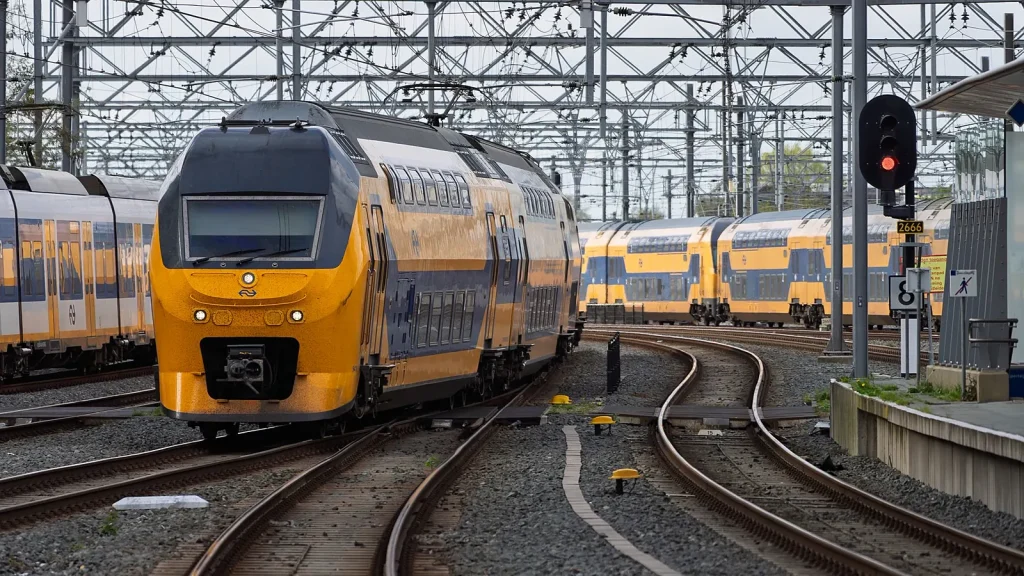
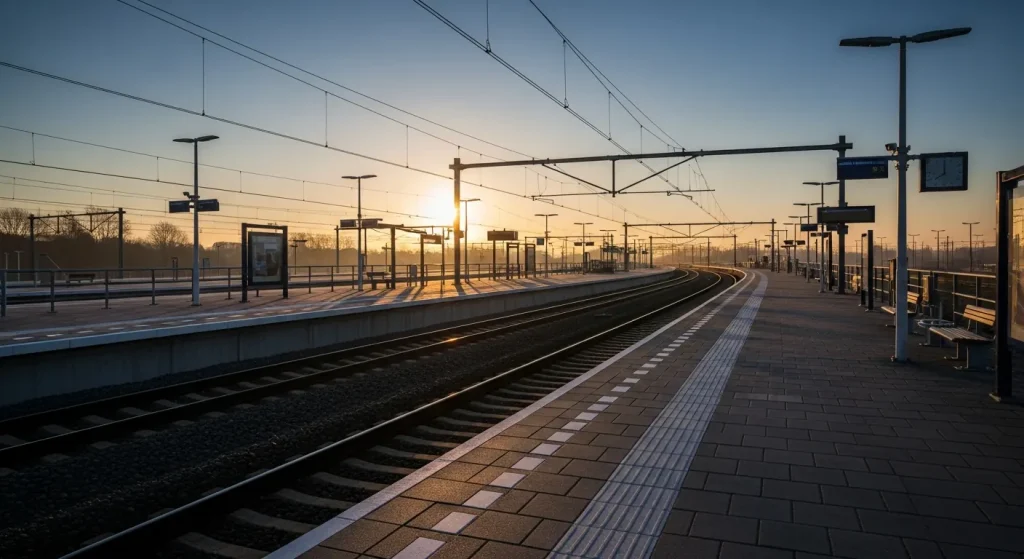
Amsterdam woke to closed metro platforms, shuttered ticket offices and ferries tied up on both sides of the IJ. In Rotterdam every metro station was locked. In The Hague not a single tram or bus left the depot. And across the country the railway was simply switched off. ProRail halted all train traffic, passenger and freight alike, from 02:00 today until 02:00 tomorrow.
One service kept moving. The Airportsprinter between Amsterdam Centraal, Schiphol and Hoofddorp ran 4 times an hour, because, in ProRail’s words, “it is socially important that Schiphol remains reachable”. Everything else stopped, including the EuroCity, Eurostar, Nightjet and ICE services inside the Netherlands, and the regional links to Antwerp and Aachen. European Sleeper’s night train kept running between Czechia, Germany and Belgium but not on Dutch track.
Outside the big cities the picture was patchy rather than blank. Arriva ran no trains at all and put its bus service at about 75 percent in Rivierenland, about 30 percent in Limburg, roughly 10 to 15 percent in Noord-Brabant and nothing in Twente. “Whether a driver strikes, we only know at the start of the shift,” the company said. Utrecht kept one tram line and about half its outer-region buses. Transdev cancelled its regular timetable outright and protected the Schiphol feeder buses above everything else. The Wadden ferries sailed normally, but you could not reach the terminal by public transport.
Not a pay dispute
None of this is a quarrel with the transport companies. “We are taking action against the cabinet and not against NS or the passengers,” FNV wrote when it confirmed the walkout. “We are also striking for the passengers, because they too can be hit by the proposed cuts to WW and WIA.” CNV told its members the same thing: “To be very clear: this is a strike aimed not at the employers, but at the cabinet.”
The fight is over social security, and specifically over 3 schemes that shape what happens to anyone in this country when work stops.
The WW is unemployment insurance, paid out of contributions that employees and employers make together, and currently running up to 24 months depending on your work history. The WIA is the benefit for people assessed as unfit or partly unfit for work after 2 years of illness. The AOW is the state pension, and the age at which you start receiving it.
The coalition agreement of D66, VVD and CDA, “Getting to work: building a better Netherlands”, proposed changes to all 3. In the government’s own words, the WW “becomes higher at the start and is shortened to 1 year”, while “the requirements in terms of building up rights and cashing them in will be somewhat tightened”. The budget annex spells out what that means: the maximum duration limited to 1 year from 2028, an entry test tightened to 42 of the last 52 weeks worked, and entitlement building up at half a month per year worked. Today the entry test is 26 weeks worked in the previous 36, and entitlement builds at a full month per year for the first 10 years. On disability the cabinet writes that it will abolish the income provision for the fully and permanently disabled, the IVA, for new cases, “so that the WIA does not become unworkable in the short term”, and set more conditions on reassessments. Its diagnosis of the system: “virtually unworkable and grinding to a halt, which means many vulnerable people are not helped in time or properly.” A separate measure cuts the maximum daily wage on which benefits are calculated by 20 percent. The state pension age was to be tied directly to rising life expectancy from 2033.
FNV, CNV and VCP gave the cabinet an ultimatum of 14 days with 2 demands: take the WW, WIA and maximum daily wage plans off the table, and scrap the accelerated rise in the AOW age. VCP chair Nic van Holstein: “Agreements worked on carefully for years are swept off the table with one stroke of the pen. A bomb in the polder.”
What the cabinet gave, and what it kept
The cabinet moved once. In a letter signed by Prime Minister Rob Jetten and 3 of his ministers, it wrote that the AOW, WW and WIA measures “were for the cabinet the opening position for this conversation”, and then: “We have decided to stop with this intended bill” on the state pension age. On the other 2, the wording was different. The proposals to shorten the WW and adjust the WIA are ones the cabinet “is for now not proceeding with in the proposed form”.
That gap between stopping and pausing is the whole dispute. Social affairs minister Hans Vijlbrief framed the move as an opening: “I want to make agreements about this with unions and employers in a pact for fair work.” But the coalition agreement scopes those 3-way talks to happen “within the financial frameworks”, meaning the savings target itself is not on the table. The cabinet also restated that it “stands by its objective of a responsible development of public finances”.
FNV’s economists went through the pre-budget figures and concluded that “well over 70 percent of the structural billion-euro cuts to social security remain standing”, itemising 1.8 billion euros on the AOW that is not funded, 1.7 billion on the WW where the halving is delayed by a year rather than scrapped, and 1.2 billion on the WIA where they say nothing changed at all. Those are the union’s own calculations from leaked figures, not published government totals.
FNV chair Hans Spekman: “Postponing cuts may produce a balanced budget, but the cabinet is planting a ticking time bomb under the social safety net of working people in the Netherlands. Anyone can fall ill or lose their job.” On the disability scheme he was blunter: “Sick people cannot go anywhere and are still being cut, while there are billions of euros in the pot for the WIA. That is simply bullying sick people.” CNV chair Hans van den Heuvel put the condition for calling everything off: “The cabinet can still prevent this by scrapping all the cuts after all. Then all the actions are off.”
Transport workers are in this fight for a specific reason. “Because of the heavy work you have an above-average chance of ending up in the WIA,” the 3 FNV transport branches told members when they called the strike. “You must be able to trust that help is there when things go wrong.” CNV adds a second front: talks on the public transport collective agreement have broken down, so its members are, in the union’s phrase, under attack from 2 sides.
The other side
The people who run the network did not enjoy it. NS president-director Wouter Koolmees called it “pretty worthless that the whole of the Netherlands cannot use public transport”, and called on “them, the cabinet and employers to sit down again and reach an agreement”. ProRail’s acting chief executive Mirjam van Velthuizen: “This is the most unpleasant decision you can take as a rail infrastructure manager. A day without trains has a big impact on society.” HTM said it respects the right to take action but finds it “incomprehensible” that an action was chosen with such consequences for passengers, noting the subject “has no direct relation to public transport”.
The operators’ association OV-NL takes no side in the political argument but called it galling that millions of travellers face the consequences of a conflict “in which the traveller and the transport companies are not a party”. Employers’ organisations VNO-NCW and MKB-Nederland say the same about their members: the unions’ quarrel is with the cabinet, not with them, and “we only reach those solutions by sitting down together, not by taking action at our members”.
The unions’ counter-argument is about the money itself. CNV calculates that 43.6 billion euros in contributions will be collected this year against 33.4 billion in benefit costs, leaving the relevant funds with around 60.8 billion, and argues that by law those contributions may not be used for other budget goals. FNV’s alternative is to raise profit tax, tackle tax evasion and tax income from wealth at least as heavily as wages.
The compensation that quietly disappeared
There is a change here that will cost stranded passengers money, and it took effect days before the strike. NS applies its strike arrangement, so travellers can claim under the “money back for delay” scheme. But NS has scrapped the separate reimbursement for alternative transport, previously up to 25 euros per person per day. Its commerce director argued in writing that working from home is now far more common, that there is no legal obligation to offer it, and that no other domestic or European railway company does.
The statutory consumer consultation body Locov, whose members include the ministry, NS, ProRail and passenger organisations, advised against the change. “We do not consider the home-working argument valid,” it wrote. “Many travellers cannot work from home, such as staff in care, education and hospitality.” It also identified exactly the trap a day like today creates: the surviving scheme requires you to check in, and “if regional public transport is also striking at that moment, in many cases they cannot even reach the station”. Locov’s advice is not binding. NS accepted its recommendation on a separate hand-luggage rule and rejected this one. NS’s own conditions record that no agreement was reached with the passengers’ association on the change.
What to plan around
NS expects to run its regular timetable tomorrow, but ProRail has warned it will take time to get rolling stock and crews back into position and expects disruption in the early hours. In Amsterdam the Noordzeekanaal ferries, the Buiksloterweg ferry and night buses N85 and N87 restart from 00:30, with everything else back on the normal timetable in the morning. Check before you leave.
No second transport strike date has been announced by either union. The campaign continues in other sectors through the week, aimed at Prinsjesdag on 15 September, when the cabinet presents the 2027 budget and the country finally sees official figures rather than leaks. FNV’s national action coordinator Cem Lacin sets the condition plainly: “As long as this cabinet does not listen, the actions continue.” CNV members in public transport vote later in the month on whether to authorise separate action over their collective agreement, which needs a 75 percent majority before anything can happen.
One more thing for the diary if you travel through Amsterdam: engineering work closes the line between Amsterdam Centraal and Weesp on Saturday 12 and Sunday 13 September, with knock-on changes to departure times and routes.